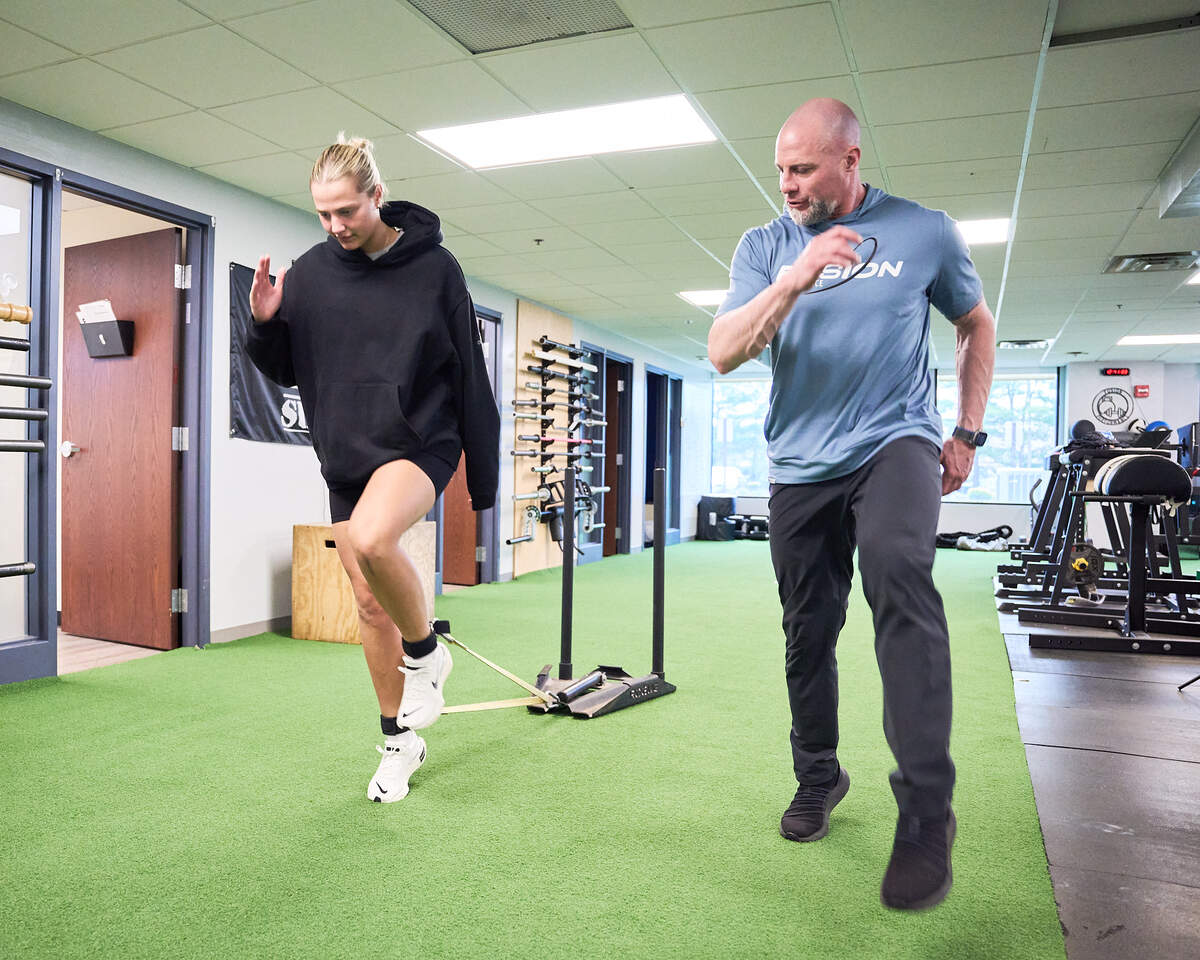
Are You Trying To Lose Weight with Interval Training? It Could be Just What You Need to Reach Your Goal!


Exercising at a steady rate simply won't achieve the same results as interval training. Many people plug away at various workouts for an hour or more each day, several days a week, with minimal results.
While interval training has been around for several years, it has recently garnered much attention to increasing fat loss.
The following information describes what interval training is, why it works, and the different ways you can incorporate it into your favorite exercise. To learn more, give Fusion Performance a call today so we can set up an appointment for you!
Interval training is also called HIIT (High-Intensity Interval Training). This type of training requires you to complete quick and intense bursts of exercise followed by short recovery periods.
By alternating your workout between intense bursts and more moderate activity, you'll keep your heart rate at a higher level while increasing the need for oxygen.
An example of a basic interval routine could include moderate walking for 2 or 3 minutes followed by 30 to 60 seconds of jogging or running.
It may be easier to divide swimming workouts into laps instead of timing your intense portions of the workout. For example, you could swim one 25-meter freestyle as quickly as possible and then complete a 25-meter backstroke at a leisurely pace.
Swimming is a great way to get an intense workout while exerting minimal strain on bones, joints, and tendons. Incorporating physical therapy into your routine can maximize muscle strength and flexibility and even promote healing.
Before starting, make sure the resistance level on the bike is high enough so that your legs don't spin out of control during the intense phase of the workout.
Begin your workout with a steady 5-minute warm-up at a moderate pace. Then, complete 30 seconds of intensity followed by 30 seconds of easy pedaling.
This should be repeated 4 or 5 times. Then increase each rep to 1 minute of intensity followed by 1 minute of easy pedaling.
The most straightforward jump rope interval workout is to simply pick a number of reps. You could jump 100 reps and then rest for 1 minute.
Repeat until you reach 1,000. You could also do timed reps. Get as many jumps in as possible in 30 seconds and then rest for 60 seconds. Just 20 minutes would provide a fairly intense workout.
Finally, you could do sliding scale intervals. This would include 300, 200, 100, and 50 reps. You would rest 60 to 90 seconds between each of the sets.
The great thing about interval training is that you can make it as easy or difficult as your fitness level allows. Your interval training could include a routine as easy as walking for 2 minutes and then running for 1 minute.
Your overall workout would last 20 to 30 minutes. A more difficult interval routine could include jogging slowly for 2 minutes and then running for 4 minutes. You could complete five cycles for a 30-minute workout.
Interval training works because you will burn more calories during the actual workout while increasing overall fat burning for the rest of the day.
What is referred to as the "afterburn effect" causes a post-exercise consumption of oxygen. Interval training will definitely make you lose weight as it increases fat burning more than what occurs with steady workouts.
You lose weight in interval training because it only requires 20 or 30 minutes per workout. It also promotes work for every fitness level.
If you are living with a painful or uncomfortable condition, interval training will likely help you. In fact, according to a study reported by the National Institutes of Health, interval training can help many patients with chronic conditions, including those living with COPD.
According to the study,
“Physical training is beneficial and should be included in the comprehensive management of all patients with COPD independently of disease severity. Different rehabilitative strategies and training modalities have been proposed to optimize exercise tolerance. Interval exercise training has been used as an effective alternative modality to continuous exercise in patients with moderate and severe COPD.”
The study concludes that interval training for patients with COPD can indeed be beneficial. As stated,
“The main purpose of this review is to summarize previous studies of the effectiveness of interval training in COPD and also to provide arguments in support of the application of interval training to overcome the respiratory and peripheral muscle limiting factors of exercise capacity. To this end, we make recommendations on how best to implement interval training in the COPD population in the rehabilitation setting so as to maximize training effects.”
However, COPD is not the only condition that can be improved with interval training. We can help determine the best training plan for your needs and your specific condition, so you can get moving comfortably once again.
Are you ready to begin interval training and reclaim your life? Contact Fusion Performance in Southington, CT 06489today to schedule a consultation and get started. Even if you've never heard of interval training before, that's okay! Our clinic can help you get well on your way to feeling your best by providing you with information about how interval training works.
Join Fusion Physical Therapy & Sports Performance in Cheshire and Southington, CT, for personalized training and rehabilitation.